The Problem
Ponding water, open seams and leaks on a flat or low-slope roof.

Assess visible issues on flat and low-slope roofing systems using materials and methods appropriate to the roof. Contact Roof Fixo to discuss your property and confirm whether this service is currently available.
Flat and low-slope roofs do not shed water like a pitched roof, so they leak differently: water moves slowly, ponds, and finds every weak seam, drain and curb flashing. Common systems are TPO, a heat-welded single-ply membrane that is reflective and durable for 15 to 25 years, EPDM rubber, flexible and long-lasting for 20 to 30 years, and modified bitumen, a cost-effective layered system for 15 to 20 years. Ponding, open seams, blisters and leaks after rain on a low-slope roof usually point to seams, drains or flashing, not to the middle of the membrane.
Flat roof repair checks membrane seams and flashing, ponding areas and drain condition, penetrations and curb flashing around units, and the deck and insulation below for softness and moisture, because a repair over wet insulation will not hold. Seams are welded or patched with the correct method for that membrane, drainage is restored so standing water clears, and where ponding or membrane failure is widespread, a larger scope is discussed rather than repeated patches.
Flat and low-slope roofs in Severna Park pond water and age at seams, because they do not shed water like a pitched roof, and because Maryland's freeze-thaw and summer heat stress membranes. A flat roof assessment here must therefore check drainage, seams and insulation together.
From Severna Park, we also serve Arnold, Annapolis, Pasadena, Glen Burnie, Millersville, Crofton, Odenton, Severn, Ellicott City, Columbia, Edgewater in Anne Arundel and Howard Counties. Use the service-area directory to review nearby community pages, then contact Roof Fixo to confirm current coverage for your address, and to discuss whether flat roof repair is the right next step for your roof or exterior.
Local pages for this service: Flat Roof Specialist in Gambrills
Browse service areas →What Severna Park homeowners call Roof Fixo about for flat roof repair, and how that call is answered, in plain terms.
Ponding water, open seams and leaks on a flat or low-slope roof.
We repair seams and drains, address ponding areas, and renew membrane sections where needed.
If you notice any of these flat roof repair signs, do not wait for the next heavy rain to confirm them.
Ponding water adds weight, accelerates membrane ageing, and finds the weakest seam on a flat roof. For ponding water on a flat roof, note when it first appeared, whether it followed rain or wind, and call 410-755-8629 to discuss flat roof repair in Severna Park.
Open seams and blisters in membrane mean the water-tight layer is already broken, and patching must address the seam, not just the blister. For open seams or blisters in membrane, note when it first appeared, whether it followed rain or wind, and call 410-755-8629 to discuss flat roof repair in Severna Park.
Low-slope leaks often come from seams, drains or curb flashing, because water moves slowly and finds every weak detail. For leaks after rain on a low-slope roof, note when it first appeared, whether it followed rain or wind, and call 410-755-8629 to discuss flat roof repair in Severna Park.
Drainage that does not clear leaves ponding on flat roofs, stressing seams and membrane until they leak. For drainage that does not clear, note when it first appeared, whether it followed rain or wind, and call 410-755-8629 to discuss flat roof repair in Severna Park.
Before any flat roof repair work is recommended, we check these flat roof repair details on your roof and exterior.
We check membrane seams and flashing for open seams, blisters and curb flashing failure on flat roofs. For membrane seams and flashing, this check tells us whether flat roof repair can be targeted, or whether a larger scope is needed.
We check ponding areas and drain condition, because standing water is the main stress on a flat roof system. For ponding areas and drain condition, this check tells us whether flat roof repair can be targeted, or whether a larger scope is needed.
We check roof deck and insulation below the membrane for softness and moisture, which decides whether a repair can hold. For roof deck and insulation below, this check tells us whether flat roof repair can be targeted, or whether a larger scope is needed.
We check penetrations and curb flashing on flat roofs, where membrane must turn up and seal around every unit. For penetrations and curb flashing, this check tells us whether flat roof repair can be targeted, or whether a larger scope is needed.
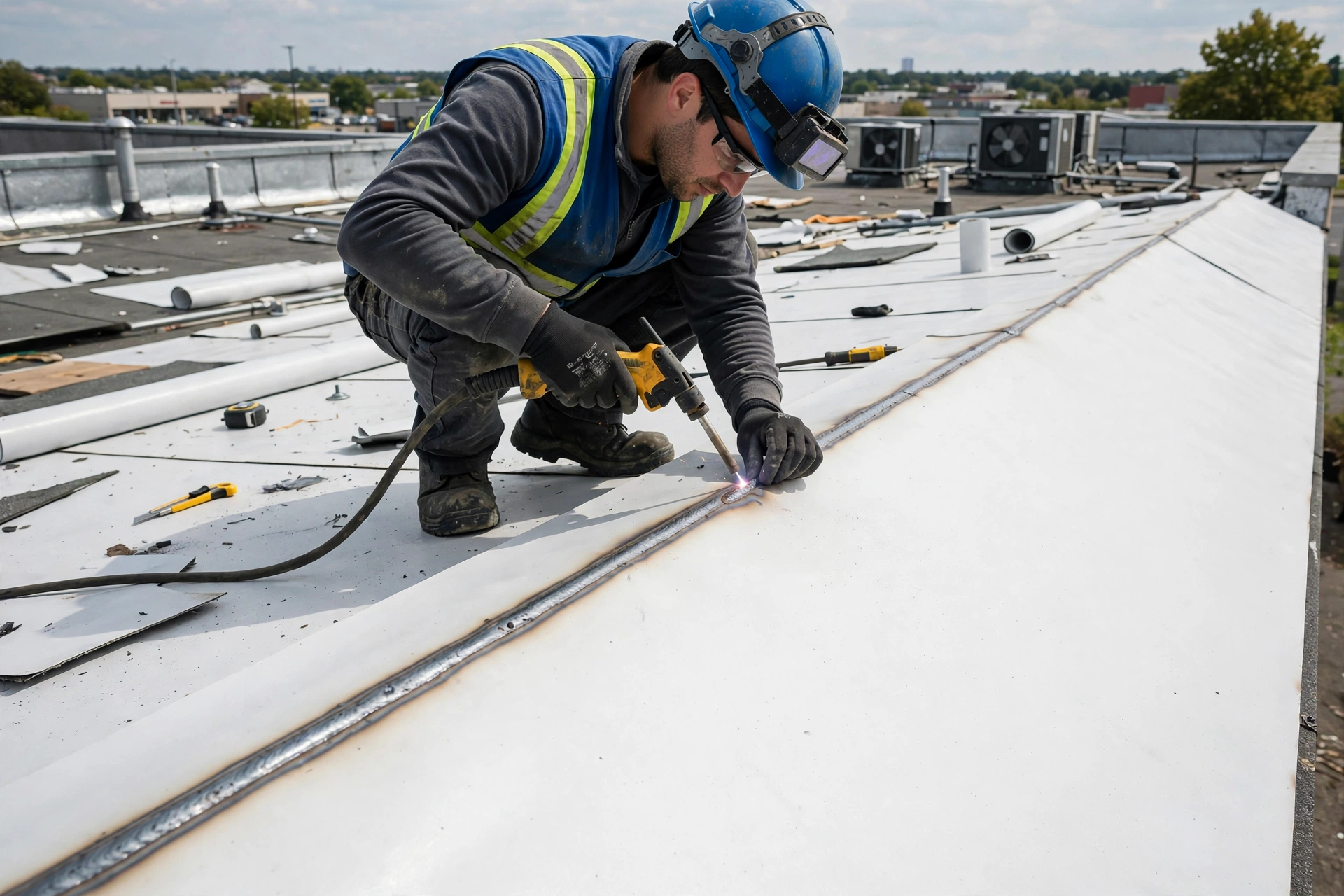
Flat and low-slope roofs in Severna Park do not shed water like a pitched roof, so water moves slowly, ponds, and finds every weak seam, drain and curb flashing, and a repair that only patches the spot above an indoor stain will not hold. Seams must be welded or patched correctly for that membrane, whether TPO, EPDM or modified bitumen, drainage must be restored so standing water clears, and deck and insulation below must be dry. The seam welding in this photo shows that method, with a hot air welder fusing a TPO seam, so the membrane becomes one water-tight layer again. Flat roof work should also check drainage, tapered insulation and scuppers, because ponding water that stays on a flat roof will find a seam, and a roof that drains to scuppers and drains, rather than trapping meltwater, lasts longer.
Local work on Severna Park roofs means we know how nor'easters, summer storms and freeze-thaw affect flat roof repair, and which details fail first in this climate.
We work with the materials that matter for flat roof repair — TPO, EPDM or modified bitumen membrane, seam welding, drains and curb flashing — and explain why each one is used.
For flat roof repair, scope, materials and steps are reviewed before work is authorized, and service availability is confirmed by phone at 410-755-8629. No hidden scope, no vague promises.
Share where water ponds, where leaks appear after rain, and what membrane system the roof has.
We check seams, drains, curb flashing, and deck and insulation below for softness and moisture.
Review the seam, drain or flashing work, and the correct method for that membrane, before work is authorised.
Seams are welded or patched correctly for that membrane, drainage is restored, and the repair is checked.
Scope depends on membrane, drainage and insulation. These factors decide the flat roof scope.
TPO, EPDM and modified bitumen need different welding and patching methods.
Ponding and blocked drains must be fixed, or a seam patch will not hold.
Wet insulation or soft decking under a membrane means a larger scope than a surface patch.
Severna Park first for flat roof repair, then these Central Maryland communities, and more in the full directory.
| Membrane | Typical life in Maryland |
|---|---|
| TPO, heat-welded single-ply | About 15 to 25 years |
| EPDM rubber | About 20 to 30 years |
| Modified bitumen, layered | About 15 to 20 years |
What homeowners say about flat roof repair in Severna Park and Central Maryland, in their own words.
"Our flat roof was ponding and leaking at a seam. The repair fixed the seam and drainage, and the roof has stayed dry since."
Homeowner, Gambrills
"Ponding that had sat for days now clears, and the seams that leaked have been welded properly."
Homeowner, Severna Park
"The crew checked drains and insulation, not just the leak spot, and the flat roof has stayed dry since."
Homeowner, Arnold
"After the next rain, drains cleared and seams held, which is what we had hoped for."
Homeowner, Annapolis
TPO is a heat-welded single-ply membrane that is reflective, durable and energy-efficient, lasting about 15 to 25 years, and it suits many low-slope roofs in Maryland. EPDM is a flexible rubber membrane that is long-lasting, about 20 to 30 years, and handles movement well, while modified bitumen is a layered, cost-effective system lasting about 15 to 20 years. The best choice depends on roof size, slope, drainage, foot traffic and budget, and on whether the existing deck and insulation are dry, because a new membrane over wet insulation will not last.
Ponding happens when a low-slope roof does not drain, because of insufficient slope, blocked drains, or sagging decking, and it is a problem because standing water adds weight, accelerates membrane ageing, and finds the weakest seam. Ponding that clears within 48 hours is less concerning than ponding that remains for days, and the fix is usually drainage, not just patching the membrane: drains are cleared, slope is restored where possible, and seams are checked. A flat roof that ponds permanently should be assessed for drainage and membrane condition together.
Flat roof leaks move slowly and find every weak seam, drain and curb flashing, because water does not shed quickly and can travel under the membrane before it shows inside. Leaks after rain on a low-slope roof usually point to seams, drains or flashing, not to the middle of the membrane, and the deck and insulation below should be checked for softness and moisture, because a repair over wet insulation will not hold. Detection therefore checks seams, drainage and penetrations together, rather than just the spot above the indoor stain.
A flat roof can be repaired when damage is limited to a few seams, a drain or a curb flashing, and when the membrane, deck and insulation underneath are dry and sound, with the correct welding or patching method for that membrane. Replacement should be discussed when ponding is widespread, when seams are failing across the roof, or when insulation is wet in several areas, because repeated patches on a failing system cost more over time. An inspection that checks membrane, drainage, deck and insulation together gives that answer.
In Maryland, EPDM rubber lasts about 20 to 30 years, TPO about 15 to 25 years, and modified bitumen about 15 to 20 years, with hot summers, cold winters, freeze-thaw and standing water shortening those numbers, especially where seams and flashing were installed poorly. Regular inspection, drain cleaning and prompt seam repair help a flat roof reach the high end of its range, while neglected ponding and clogged drains shorten it quickly. If you do not know your flat roof's age or system, an inspection can identify the membrane and judge remaining life.
A flat roof needs regular drain and gutter cleaning, because blocked drains cause ponding, and regular checks for open seams, blisters, curb flashing and foot traffic damage, especially after storms and freeze-thaw. Debris should be removed, because it holds water against the membrane, and any new penetration, such as a vent or unit, should be flashed correctly, not just sealed. An annual inspection, ideally in spring or after a major storm, catches small seam and drainage issues before they become leaks.
Call to discuss your flat roof repair concern and verify current service availability.