The Problem
Wind-lifted shingles, hail impact, fallen limbs and water coming in after a storm.

Assess visible wind and storm damage and determine the next safe steps for protecting the property. Contact Roof Fixo to discuss your property and confirm whether this service is currently available.
Storm damage in Severna Park usually follows a nor'easter or a summer thunderstorm: wind lifts shingle tabs and breaks their seal, hail bruises the shingle mat and knocks granules off, and fallen limbs crack shingles, dent flashing and puncture underlayment. Damage is often not limited to the wet spot inside, because wind direction and roof slope decide which slopes take the hit, and hail damage may not leak immediately but still shortens roof life. A whole-roof survey, slope by slope, is needed before any repair is planned.
Work starts with safety and temporary protection where a storm opening is letting water in, then a photo record of lifted, cracked and missing shingles, flashing damage and attic signs, slope by slope, so the damage is documented clearly. Permanent repair then replaces the damaged shingles and flashing, checks underlayment and decking under the impact, and confirms whether the surrounding roof is sound enough for a partial repair or whether the damage is widespread enough to discuss replacement.
Severna Park sits in the path of nor'easters and summer thunderstorms, so storm damage here is often wind on one slope and hail on another, with debris and limb impact adding a third pattern. A storm assessment must therefore survey every slope, not just the slope above a wet ceiling.
From Severna Park, we also serve Arnold, Annapolis, Pasadena, Glen Burnie, Millersville, Crofton, Odenton, Severn, Ellicott City, Columbia, Edgewater in Anne Arundel and Howard Counties. Use the service-area directory to review nearby community pages, then contact Roof Fixo to confirm current coverage for your address, and to discuss whether storm damage repair is the right next step for your roof or exterior.
Local pages for this service: Storm Damage Repair in Edgewood Arsenal · Storm Damage Repair in Edgewood · Storm Damage Repair in Fallston · Storm Damage Roof Repair in Edgewater · Storm Damage Roof Repair in Severna Park
Browse service areas →What Severna Park homeowners call Roof Fixo about for storm damage repair, and how that call is answered, in plain terms.
Wind-lifted shingles, hail impact, fallen limbs and water coming in after a storm.
We inspect the whole roof, photograph damage for your records, tarp open sections when needed, and repair the damaged areas.
If you notice any of these storm damage repair signs, do not wait for the next heavy rain to confirm them.
Torn shingles leave a gap in the weather course, and the exposed underlayment is not designed to be a long-term roof surface. For shingles lifted or torn off by wind, note when it first appeared, whether it followed rain or wind, and call 410-755-8629 to discuss storm damage repair in Severna Park.
Hail marks are bruises in the shingle mat that may not leak today, but they shorten life and should be recorded promptly. For hail marks and cracked shingles, note when it first appeared, whether it followed rain or wind, and call 410-755-8629 to discuss storm damage repair in Severna Park.
Post-storm water entry usually follows wind-lifted shingles or debris damage, and needs a whole-roof check, not just the wet spot. For water entry after a storm, note when it first appeared, whether it followed rain or wind, and call 410-755-8629 to discuss storm damage repair in Severna Park.
Limb and debris impact can crack shingles, dent flashing and puncture underlayment, even when the damage looks small from below. For debris or limb damage on the roof, note when it first appeared, whether it followed rain or wind, and call 410-755-8629 to discuss storm damage repair in Severna Park.
Before any storm damage repair work is recommended, we check these storm damage repair details on your roof and exterior.
We survey the whole roof for wind and hail damage, slope by slope, so no damaged area is missed. For whole-roof wind and hail survey, this check tells us whether storm damage repair can be targeted, or whether a larger scope is needed.
We check flashing and penetration damage across the roof, including boots, collars and curb flashing. For flashing and penetration damage, this check tells us whether storm damage repair can be targeted, or whether a larger scope is needed.
We check attic and ceiling water signs, mapping stains to roof details above them. For attic and ceiling water signs, this check tells us whether storm damage repair can be targeted, or whether a larger scope is needed.
We take photos and notes for your records, slope by slope, so storm damage is documented clearly. For photos and notes for your records, this check tells us whether storm damage repair can be targeted, or whether a larger scope is needed.
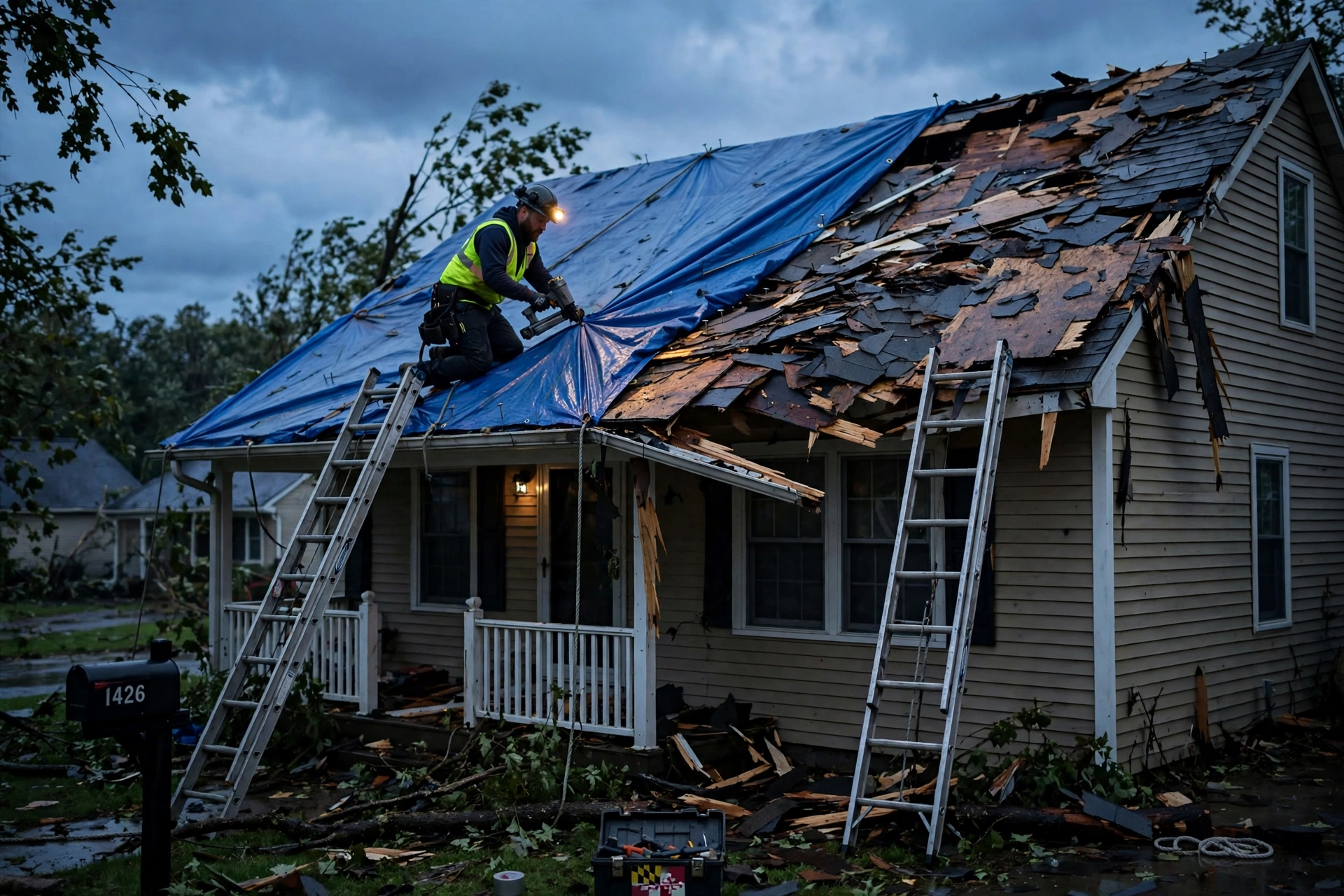
Storm damage in Severna Park rarely stops at the wet spot inside, because wind direction and roof slope decide which slopes take the hit, and hail can bruise a shingle mat without an obvious hole. A survey that looks at every slope, with photos and notes, is what separates storm damage from pre-existing ageing, and it is what an insurer needs to see. The work in this photo is the permanent repair that follows temporary protection, with damaged shingles replaced and the surrounding roof checked, so the same storm does not leave a second leak behind. Storm documentation should be slope by slope, with photos of hail bruising, wind-lifted tabs, dented flashing and damaged valleys, because that record is what an adjuster needs to assess a claim, and your insurer decides coverage, not the contractor.
Local work on Severna Park roofs means we know how nor'easters, summer storms and freeze-thaw affect storm damage repair, and which details fail first in this climate.
We work with the materials that matter for storm damage repair — shingles, flashing, underlayment and temporary protection materials — and explain why each one is used.
For storm damage repair, scope, materials and steps are reviewed before work is authorized, and service availability is confirmed by phone at 410-755-8629. No hidden scope, no vague promises.
Share when the storm happened, what you saw, and whether water is actively entering.
Where a storm opening is letting water in, temporary cover is applied before a permanent repair.
We survey every slope for wind and hail damage, with photos and notes for your records.
Damaged shingles and flashing are replaced, decking is checked, and the repair is checked before we leave.
Scope depends on what the storm did, slope by slope. These factors decide the storm scope.
Damage limited to one slope is a different job from hail bruising across several slopes.
Decking and underlayment under an impact must be checked, not just the visible hole.
Emergency cover and permanent repair are separate steps, with different timing.
Severna Park first for storm damage repair, then these Central Maryland communities, and more in the full directory.
What homeowners say about storm damage repair in Severna Park and Central Maryland, in their own words.
"After the storm, the team came out, walked the whole roof, and repaired the wind damage quickly. They explained every damaged area before starting work."
Homeowner, Arnold
"Photos of every slope helped us understand the damage, and the repair was done properly, not rushed."
Homeowner, Severna Park
"Temporary cover went on quickly, and the permanent repair followed without us having to chase anyone."
Homeowner, Arnold
"A final check after the repair confirmed no new damage had been missed."
Homeowner, Annapolis
Wind damage shows as lifted or torn shingle tabs, broken seals and missing shingles, often on the windward slope, while hail damage shows as bruises in the shingle mat, knocked-off granules and dented flashing, which may not leak immediately. Fallen limbs can crack shingles, dent flashing and puncture underlayment in one spot, and the hidden damage around the impact matters as much as the visible hole. A whole-roof survey, slope by slope, is needed, because damage is rarely limited to the wet spot inside.
Many policies cover wind and hail damage, while wear from age or lack of maintenance typically is not covered, so documenting what the storm did, separately from pre-existing ageing, is important. Photos and notes, slope by slope, of lifted, cracked and missing shingles, flashing damage and attic signs help an adjuster assess the claim, and a clear scope helps separate storm damage from an old roof. Your insurer decides coverage, so keep the documentation for your records.
A tarp is short-term protection, not a repair: sun and wind wear tarps out, and the longer one stays, the more chance water sneaks under it and soaks decking and insulation. Get the permanent repair scheduled as soon as you reasonably can, and keep checking the tarp from the ground after each storm, especially after wind. If you are waiting on an insurance decision, ask your roofer and your insurer how to handle timing, and do not leave a tarp in place through a winter.
Repair is right when damage is limited to one slope or a few details and the surrounding roof is sound, with matching shingles and flashing that tie in cleanly. Replacement should be discussed when damage is widespread, when hail bruising covers several slopes, or when the roof is already near the end of its life, because repeated repairs on an old system cost more over time. An inspection that judges damage extent, roof age and remaining life together gives that answer.
Stay off the roof, especially when it is wet or damaged, and move items away from wet areas if it is safe, keeping away from wet electrics and fixtures. Take ground-level photos of visible damage, fallen limbs and interior water, and note when the storm happened and what you saw. Do not attempt a permanent repair yourself in a storm, and call to discuss temporary protection, because a safe temporary cover now prevents a much larger interior repair later.
Yes, with cold-weather sealants and adhesives, and with work done only when the roof is dry and safe, though permanent repairs may need to wait for a dry spell after a storm. Temporary protection can be applied first to stop water entering, and the permanent repair can then be scheduled when conditions allow. Waiting through a winter without any protection is the risky option, because freeze-thaw will widen every crack and soak decking further.
Call to discuss your storm damage repair concern and verify current service availability.