The Problem
Leaks at chimneys, walls, valleys and roof penetrations where flashing has cracked or separated.

Inspect and repair flashing details around chimneys, walls, valleys and roof penetrations. Contact Roof Fixo to discuss your property and confirm whether this service is currently available.
Flashing is the sheet metal that seals roof-to-wall transitions, and it is where most slow leaks begin: step flashing at walls, counter-flashing tucked into chimney masonry, valley metal where two slopes meet, and boots and collars at vents and skylights. In Severna Park, freeze-thaw cracks sealant, salt air corrodes metal, and wind pulls flashing away, and a thick bead of caulk over a failed joint is not a repair, because the underlying water-management layer is still broken. Stains near a chimney usually point to chimney flashing, stains near an interior wall to step flashing.
Flashing repair rebuilds the joint properly: old, rusted or separated metal is removed, new step flashing is woven with shingle courses, counter-flashing is sealed into masonry, valley metal is checked for rust and lifting, and sealant and fasteners are renewed as a secondary seal, not the only seal. Kick-out diverters are checked where a wall meets a roof, because without one, valley water runs straight down the wall and into siding.
Flashing joints in Severna Park age faster than shingles, because salt air corrodes metal, freeze-thaw cracks sealant, and masonry pointing loosens around chimneys. A flashing assessment here must therefore check every joint type separately, not just the joint above a stain.
From Severna Park, we also serve Arnold, Annapolis, Pasadena, Glen Burnie, Millersville, Crofton, Odenton, Severn, Ellicott City, Columbia, Edgewater in Anne Arundel and Howard Counties. Use the service-area directory to review nearby community pages, then contact Roof Fixo to confirm current coverage for your address, and to discuss whether roof flashing repair is the right next step for your roof or exterior.
Browse service areas →What Severna Park homeowners call Roof Fixo about for roof flashing repair, and how that call is answered, in plain terms.
Leaks at chimneys, walls, valleys and roof penetrations where flashing has cracked or separated.
We rebuild step flashing, counter-flashing and valley metal, and reseal the joint so water sheds correctly.
If you notice any of these roof flashing repair signs, do not wait for the next heavy rain to confirm them.
Leaks at chimneys and walls are almost always flashing joints, where step flashing, counter-flashing and sealant meet masonry. For leaks at chimneys or walls, note when it first appeared, whether it followed rain or wind, and call 410-755-8629 to discuss roof flashing repair in Severna Park.
Rusted or separated flashing no longer sheds water, and rain follows the metal straight into the wall. For rust, cracks or separation in flashing, note when it first appeared, whether it followed rain or wind, and call 410-755-8629 to discuss roof flashing repair in Severna Park.
Stains near a joint point to that joint's flashing, not to the field of the roof, and the joint needs rebuilding. For water stains near a roof joint, note when it first appeared, whether it followed rain or wind, and call 410-755-8629 to discuss roof flashing repair in Severna Park.
Flashing pulled away after wind leaves a direct path for rain into the roof structure at that joint. For flashing pulled away after wind, note when it first appeared, whether it followed rain or wind, and call 410-755-8629 to discuss roof flashing repair in Severna Park.
Before any roof flashing repair work is recommended, we check these roof flashing repair details on your roof and exterior.
We check step flashing and counter-flashing for cracks, separation and sealant failure at each joint. For step flashing and counter-flashing, this check tells us whether roof flashing repair can be targeted, or whether a larger scope is needed.
We check valley metal and drip edge for rust, lifting and sealant failure, where two slopes concentrate water. For valley metal and drip edge, this check tells us whether roof flashing repair can be targeted, or whether a larger scope is needed.
We check chimney and wall joints for step flashing, counter-flashing and masonry sealant failure. For chimney and wall joints, this check tells us whether roof flashing repair can be targeted, or whether a larger scope is needed.
We check sealant and fastener condition, because failed sealant and loose fasteners let water past otherwise sound flashing. For sealant and fastener condition, this check tells us whether roof flashing repair can be targeted, or whether a larger scope is needed.
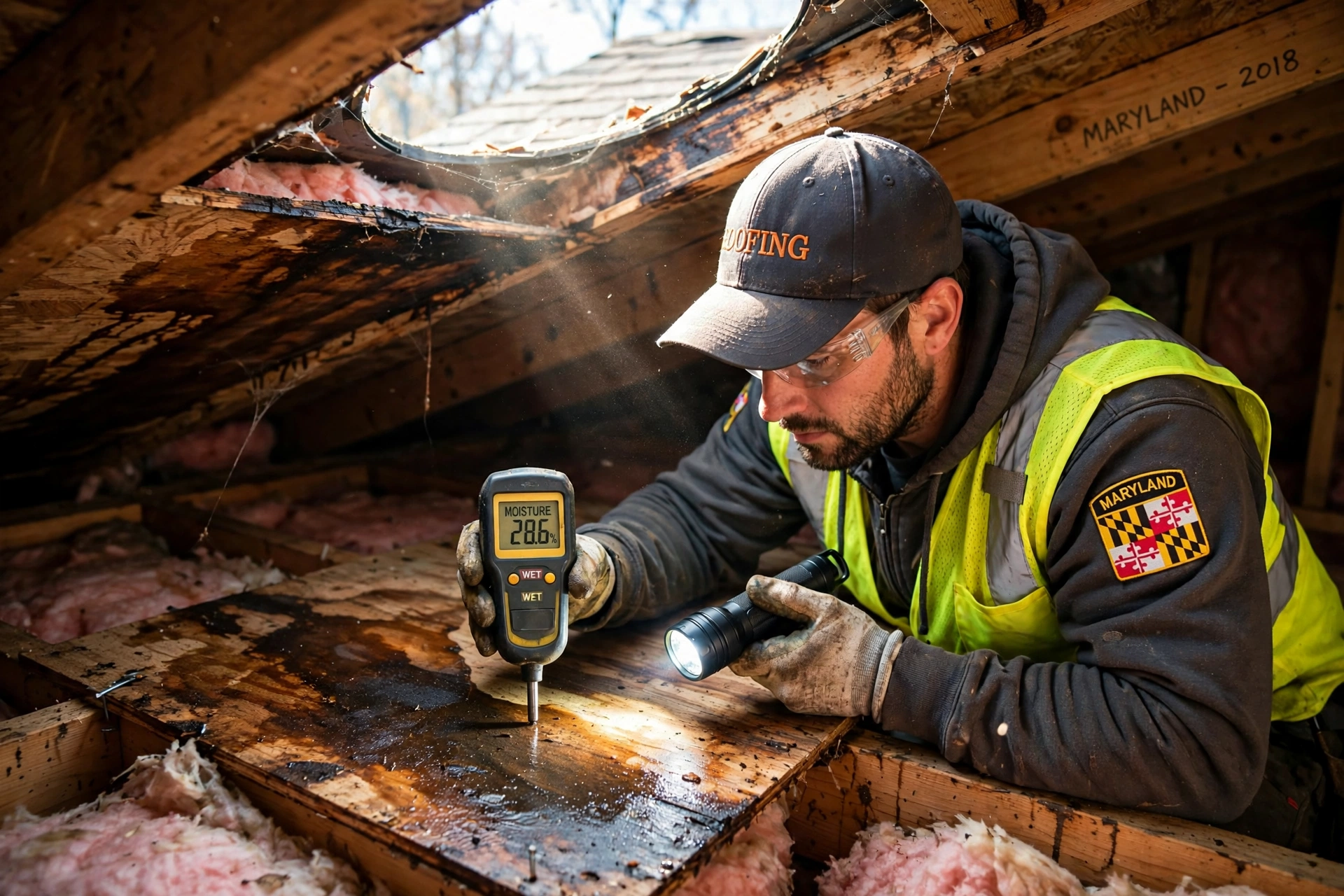
Flashing is the metal that seals where a roof meets something else, a chimney, a wall, a valley or a vent, and it is where most slow leaks in Severna Park begin, because a joint concentrates water, moves with temperature, and relies on overlapping metal, not on a single surface. When step flashing cracks, counter-flashing pulls out of masonry, or valley metal rusts, water follows the metal straight into the wall, and sealant alone will not fix it. The close-up in this photo shows a flashing joint being sealed properly, with metal and sealant working together, not sealant hiding a broken joint. Kick-out flashing, also called a diverter, is a key detail here: where a roof meets a wall, it should kick water into the gutter, not let it run down the wall and into the siding and sheathing below.
Local work on Severna Park roofs means we know how nor'easters, summer storms and freeze-thaw affect roof flashing repair, and which details fail first in this climate.
We work with the materials that matter for roof flashing repair — step flashing, counter-flashing, valley metal, sealant and fasteners — and explain why each one is used.
For roof flashing repair, scope, materials and steps are reviewed before work is authorized, and service availability is confirmed by phone at 410-755-8629. No hidden scope, no vague promises.
Share whether the stain is near a chimney, wall, valley or vent, and when it first appeared.
We check step flashing, counter-flashing, valley metal, sealant and masonry condition at each joint.
Review the joint to be rebuilt, the metal and sealant to be used, before work is authorised.
Old metal is removed, new flashing is woven or tucked correctly, and the joint is checked for water shedding.
Scope depends on which joint, and how it was built. These factors decide the flashing scope.
Step, counter, valley and boot flashing are different rebuilds, with different metal work.
Counter-flashing tucked into crumbling masonry needs masonry work, not just metal.
Shingles around a joint must be lifted and re-laid correctly, or the new flashing will leak at its edge.
Severna Park first for roof flashing repair, then these Central Maryland communities, and more in the full directory.
| Flashing type | Where it fails |
|---|---|
| Step flashing | Wall to slope joints, sealant cracks |
| Counter-flashing | Chimney masonry, pulls out of mortar |
| Valley metal | Two slopes meet, rust and lifting |
What homeowners say about roof flashing repair in Severna Park and Central Maryland, in their own words.
"The leak was always at the chimney. New flashing was installed properly, sealed, and the wall below has stayed completely dry."
Homeowner, Annapolis
"Chimney flashing that had leaked for years is now rebuilt properly, with metal, not just sealant."
Homeowner, Severna Park
"Valley metal was replaced and sealed correctly, and the wall below it has stayed dry."
Homeowner, Arnold
"Joints were checked for water shedding after the rebuild, and they have held since."
Homeowner, Annapolis
Flashing is the sheet metal that seals roof-to-wall transitions: step flashing where a wall meets a slope, counter-flashing tucked into chimney masonry, valley metal where two slopes meet, and boots and collars at vents and skylights. Most slow leaks begin at these joints, not in the open field of shingles, because a joint concentrates water, moves with temperature, and relies on overlapping metal and sealant, not on a single surface. When flashing rusts, cracks, separates or is sealed with caulk alone, water follows the metal straight into the wall or attic.
Water stains near a chimney usually point to chimney flashing, stains near an interior wall or dormer often trace back to step flashing, and stains along a valley line point to valley metal, but the attic and roof must be checked to confirm, because water travels. A roofing inspection checks each joint for rust, separation, sealant failure and masonry condition, and maps attic staining to the joint above it, rather than guessing from the indoor stain. That confirmation matters, because repairing the wrong flashing will not stop the leak.
Storm-related flashing failures are often covered, while wear from age, rust or lack of maintenance typically is not, so the cause and the documentation matter. Photos of rusted, separated or wind-pulled flashing, plus attic signs, help an insurer see whether a storm or age caused the failure, and a clear scope separates storm damage from long-term ageing. Your insurer decides coverage, so keep the documentation for your records and share it with them.
Sealants perform best in moderate temperatures, though cold-weather repairs are possible with specialised sealant products and with work done only when the roof is dry and safe. Metal flashing itself can be replaced in cold weather, but sealant bonding and shingle handling need more care, and a repair done in a dry cold spell is better than waiting while water keeps entering. Temporary protection can be applied first if conditions are not safe for a permanent rebuild.
An annual inspection, ideally in spring or after a major storm, helps catch small flashing issues before they turn into leaks, because flashing fails gradually: sealant cracks, metal corrodes, and masonry pointing loosens, often without an indoor sign until the next heavy rain. Chimney, valley and wall flashing should be checked together, because a failure at one joint can look like a leak at another, and because valleys carry more water per square foot than any flat run of shingles. Regular checks are especially important in Severna Park, where freeze-thaw and salt air age metal and sealant faster.
Sealant has legitimate uses, but it should not be confused with a complete water-management system: a roof relies on overlapping materials, drainage planes, underlayment, flashing and carefully managed transitions. If step flashing is missing, valley metal is rusted, or counter-flashing has pulled out of masonry, a thick bead of caulk over the joint may hide the problem for a season, but water will find the underlying pathway again. A proper flashing repair rebuilds the joint, with sealant as a secondary seal, not the only seal.
Call to discuss your roof flashing repair concern and verify current service availability.