The Problem
Gutters that overflow, are undersized, or send water toward the foundation.

Plan gutter and downspout installation to move rainwater away from the roofline and foundation. Contact Roof Fixo to discuss your property and confirm whether this service is currently available.
Gutter installation is about sizing, not just hanging a trough. A Severna Park roof in a Maryland downpour needs a system matched to roof area, pitch and rainfall: the common size is a 5-inch seamless gutter, with 6-inch where roof area or pitch is larger, and downspouts sized as 2x3 for roughly every 600 square feet of roof, or 3x4 for roughly every 1,200. Too few downspouts, or downspouts that discharge at the foundation, undo good gutter work, because water then pools at the footing, erodes soil and enters basements.
Installation fabricates seamless runs on site to exact measurements, so there are no joints along the run to leak, with hidden hangers spaced to support snow and ice without sagging, a pitch of about a quarter inch per 10 feet toward downspouts, and downspouts placed roughly every 40 feet, discharging at least four to five feet from the foundation. Fascia is checked first, because new gutters on rotted fascia will pull away again, and gutter guards are discussed where tree cover makes debris a constant problem.
Severna Park roofs in a Maryland downpour deliver a large volume of water to gutters, and that volume, combined with tree cover and freeze-thaw, decides gutter size, downspout count and discharge. A gutter assessment here must therefore start with roof area and rainfall, not with gutter length alone.
From Severna Park, we also serve Arnold, Annapolis, Pasadena, Glen Burnie, Millersville, Crofton, Odenton, Severn, Ellicott City, Columbia, Edgewater in Anne Arundel and Howard Counties. Use the service-area directory to review nearby community pages, then contact Roof Fixo to confirm current coverage for your address, and to discuss whether gutter installation is the right next step for your roof or exterior.
Local pages for this service: Gutter Installation in Anne Arundel County · Gutter Installation in Severna Park · Gutters in Anne Arundel County
Browse service areas →What Severna Park homeowners call Roof Fixo about for gutter installation, and how that call is answered, in plain terms.
Gutters that overflow, are undersized, or send water toward the foundation.
New gutters in the right size and pitch, with downspouts placed to move rainwater away from the home.
If you notice any of these gutter installation signs, do not wait for the next heavy rain to confirm them.
Overflowing gutters send water down fascia and siding and pool it at the foundation, damaging eaves and basement walls over time. For gutters overflowing in rain, note when it first appeared, whether it followed rain or wind, and call 410-755-8629 to discuss gutter installation in Severna Park.
Pooling at the foundation can enter basements, erode soil and damage footing drainage, so gutter and grading work together. For water pooling near the foundation, note when it first appeared, whether it followed rain or wind, and call 410-755-8629 to discuss gutter installation in Severna Park.
Undersized or sagging gutters cannot carry a Maryland downpour, so water spills at corners and backs up under the roof edge. For undersized or sagging gutters, note when it first appeared, whether it followed rain or wind, and call 410-755-8629 to discuss gutter installation in Severna Park.
Downspouts that discharge at the foundation undo good gutter work; they need to move water well away from the house. For downspouts in the wrong place, note when it first appeared, whether it followed rain or wind, and call 410-755-8629 to discuss gutter installation in Severna Park.
Before any gutter installation work is recommended, we check these gutter installation details on your roof and exterior.
We check roof area and rainfall run-off to size gutters correctly for Maryland storms. For roof area and rainfall run-off, this check tells us whether gutter installation can be targeted, or whether a larger scope is needed.
We check gutter size, pitch and hangers against roof area and rainfall, because undersized gutters overflow even when clean. For gutter size, pitch and hangers, this check tells us whether gutter installation can be targeted, or whether a larger scope is needed.
We check downspout placement and drainage, ensuring water moves well away from the foundation. For downspout placement and drainage, this check tells us whether gutter installation can be targeted, or whether a larger scope is needed.
We check fascia condition for mounting, since new gutters on rotted fascia will pull away again. For fascia condition for mounting, this check tells us whether gutter installation can be targeted, or whether a larger scope is needed.
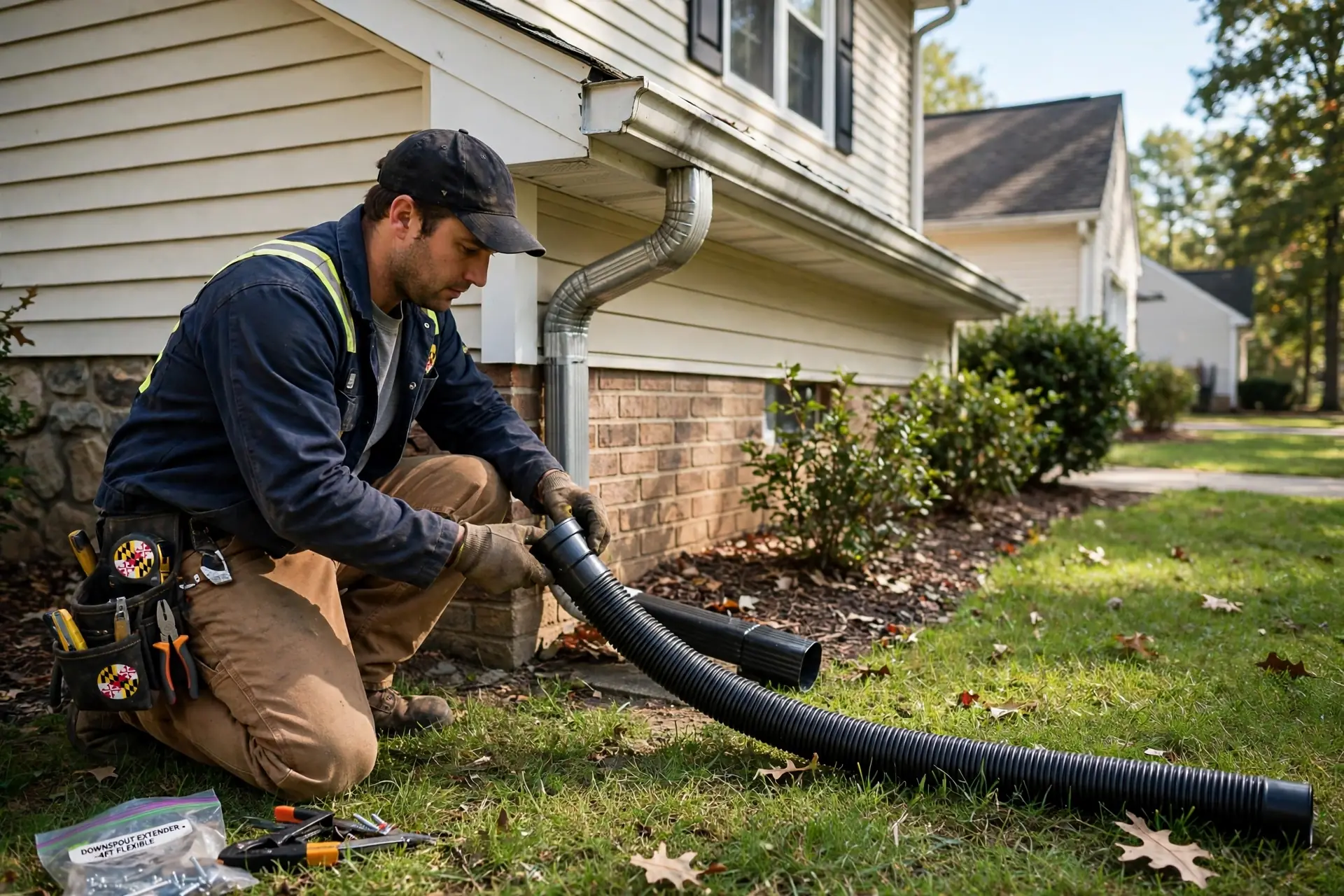
A Severna Park gutter that overflows in a Maryland downpour is usually not a cleaning problem, it is a sizing problem: too few downspouts, a gutter too small for the roof area above it, or downspouts that discharge at the foundation. Sizing by roof area, pitch and rainfall, with 5-inch or 6-inch seamless runs, downspouts placed roughly every 40 feet, and discharge at least four to five feet from the foundation, is what makes a system work in a storm. The downspout work in this photo shows that last step, moving water well away from the house, where it cannot erode soil or enter a basement. K-style gutters, with their decorative ogee face, are the most common choice for Maryland homes, while half-round gutters suit traditional and historic homes, and .032-gauge aluminium is the practical default for seamless runs, with downspout sizes from 2 by 3 inches to 3 by 4 inches matched to the roof area above each run.
Local work on Severna Park roofs means we know how nor'easters, summer storms and freeze-thaw affect gutter installation, and which details fail first in this climate.
We work with the materials that matter for gutter installation — seamless aluminium gutters, hidden hangers, downspouts and extensions — and explain why each one is used.
For gutter installation, scope, materials and steps are reviewed before work is authorized, and service availability is confirmed by phone at 410-755-8629. No hidden scope, no vague promises.
Share where gutters overflow, where water pools, and how large the roof area above is.
We measure each run, check fascia, and size gutters and downspouts for roof area and Maryland rainfall.
Review gutter size, downspout placement and discharge, before work is authorised.
Seamless runs are fabricated on site, hung with correct pitch and hangers, and checked for flow and discharge.
Scope depends on roof area and drainage, not just gutter length. These factors decide the gutter scope.
Larger roof area or steeper pitch needs larger gutters and more downspouts.
Rotted fascia must be replaced before new gutters go on, or they will pull away again.
Downspout count, size and discharge location decide whether water actually moves away from the foundation.
Severna Park first for gutter installation, then these Central Maryland communities, and more in the full directory.
| Item | Common guide |
|---|---|
| Gutter size | 5-inch seamless, 6-inch for larger roof area or pitch |
| Downspout | 2x3 per roughly 600 sq ft, 3x4 per roughly 1,200 sq ft |
| Downspout spacing | Roughly every 40 feet of gutter |
| Discharge | At least 4 to 5 feet from the foundation |
What homeowners say about gutter installation in Severna Park and Central Maryland, in their own words.
"New gutters changed everything. Rain now flows away from the house instead of overflowing and pooling by the foundation."
Homeowner, Glen Burnie
"Every run was measured, fascia was checked, and downspouts now send water well away from the house."
Homeowner, Severna Park
"No more overflow in a downpour, and the new gutters look like they were always part of the house."
Homeowner, Arnold
"After the next downpour, gutters were checked for flow, and everything drained exactly as planned."
Homeowner, Annapolis
Seamless gutters are custom-fabricated on site from a single continuous piece of material, usually aluminium, to the exact measurements of your home, so there are no joints along the gutter run to leak or catch debris. Sectional gutters, sold in short lengths, have joints every few feet, and each joint is a potential leak point, especially as sealant ages in Maryland's freeze-thaw. Seamless gutters represent most new installations in the United States for that reason, and they are available in 5-inch and 6-inch profiles, in aluminium, steel and copper.
The most common size is a 5-inch seamless gutter, with 6-inch where roof area or pitch is larger, and downspouts are sized to match: 2x3 downspouts for roughly every 600 square feet of roof area, or 3x4 downspouts for roughly every 1,200 square feet. A common guideline is one downspout for every 40 feet of gutter, though roof size, pitch and corners change that number, and too few downspouts force water to back up and overflow. An installer should divide the roof into drainage zones and size each zone, rather than using one size for every home.
A downspout should direct water at least four to five feet away from the foundation, and ideally further where grading slopes toward the house, because water discharged at the footing saturates soil, erodes it, and can enter basements or crawl spaces. Splash blocks or downspout extensions are part of a correct installation, not an optional extra, and homes with poor grading may need longer extensions or an alternative discharge location. If you see erosion channels or mulch wash-out at a downspout base, the discharge point is too close or too concentrated.
Most installations are completed in a single day, because seamless runs are fabricated on site with a truck-mounted machine and hung with hidden hangers spaced to support snow and ice without sagging. The work includes measuring each run, checking fascia for rot, setting a pitch of about a quarter inch per 10 feet toward downspouts, and placing downspouts and extensions so water moves away from the foundation. Fascia must be in place and sound before installation, because new gutters on rotted fascia will pull away again.
Gutter guards reduce debris entry and cleaning frequency, which helps in Severna Park where tree cover is heavy, but they are not maintenance-free, and the right guard depends on leaf load, roof pitch and gutter size. Guards that cannot keep up with debris will overflow in a downpour, and a guard that blocks water in a storm is worse than no guard. An installer should size downspouts and recommend a guard that can actually handle the debris and rainfall your home sees, rather than selling one guard for every home.
Correctly installed gutters have a slight slope toward downspouts, so water does not pool, are securely fastened to fascia with no sagging or gaps, sit directly beneath the roof edge to catch all runoff, and have tight seams and downspouts that discharge well away from the foundation. After a heavy rain, check for overflow, for water stains on fascia below the gutter, and for gutters that remain full minutes after rain stops, all of which mean sizing, pitch or downspout placement is wrong. A final check after installation should confirm those points, not just that the gutters look straight.
Call to discuss your gutter installation concern and verify current service availability.