The Problem
Leaking joints, sagging sections, loose hangers and clogged or pulling gutters.

Address leaking joints, sagging sections, loose hangers and drainage issues in existing gutters. Contact Roof Fixo to discuss your property and confirm whether this service is currently available.
Gutter repair is needed when joints leak at corners, sections sag or pull away from fascia, hangers loosen, or water overflows in moderate rain even when the gutter looks clean. Common causes are failed sealant at joints, too few hangers, fascia rot behind the gutter, incorrect pitch that leaves standing water, and downspouts that are blocked or discharge at the foundation. Overflow during moderate rain, stains on fascia below the gutter, and mulch wash-out at a downspout base are all signs the system cannot keep pace with the roof above it.
Repair reseals joints after cleaning and drying, re-secures sagging sections with correctly spaced hangers, restores pitch so water flows to downspouts instead of pooling, clears downspout blockages, and moves discharge away from the foundation where needed. Fascia attachment is checked at the same time, because a gutter that pulls away usually means fascia is rotting or hangers have failed, and both need fixing together. Where leaks are widespread or the system is rusted through, a section replacement is discussed instead of another sealant attempt.
Gutters in Severna Park fail most often from a combination of debris, ice and fascia rot, because tree cover clogs runs, winter ice adds weight, and overflow keeps fascia wet. A gutter assessment here must therefore check pitch, hangers, fascia and downspouts as one system.
From Severna Park, we also serve Arnold, Annapolis, Pasadena, Glen Burnie, Millersville, Crofton, Odenton, Severn, Ellicott City, Columbia, Edgewater in Anne Arundel and Howard Counties. Use the service-area directory to review nearby community pages, then contact Roof Fixo to confirm current coverage for your address, and to discuss whether gutter repair is the right next step for your roof or exterior.
Browse service areas →What Severna Park homeowners call Roof Fixo about for gutter repair, and how that call is answered, in plain terms.
Leaking joints, sagging sections, loose hangers and clogged or pulling gutters.
We reseal joints, refasten hangers, correct pitch, and replace sections that are beyond repair.
If you notice any of these gutter repair signs, do not wait for the next heavy rain to confirm them.
Leaking joints and corners drip constantly, staining siding, eroding soil and keeping fascia wet. For leaking gutter joints and corners, note when it first appeared, whether it followed rain or wind, and call 410-755-8629 to discuss gutter repair in Severna Park.
A sagging gutter pulls on fascia, loses pitch, and holds water that rots boards and breeds mosquitoes. For sagging or pulling gutter sections, note when it first appeared, whether it followed rain or wind, and call 410-755-8629 to discuss gutter repair in Severna Park.
Loose hangers let a gutter sag and pull away, changing pitch and putting extra weight on fascia boards. For loose hangers and brackets, note when it first appeared, whether it followed rain or wind, and call 410-755-8629 to discuss gutter repair in Severna Park.
Clogged sections back water up under shingles and over fascia, so cleaning and pitch matter as much as the gutter itself. For clogged or overflowing sections, note when it first appeared, whether it followed rain or wind, and call 410-755-8629 to discuss gutter repair in Severna Park.
Before any gutter repair work is recommended, we check these gutter repair details on your roof and exterior.
We check joint seals and corner condition for failed sealant, which is the most common gutter leak source. For joint seals and corner condition, this check tells us whether gutter repair can be targeted, or whether a larger scope is needed.
We check hanger spacing and fascia attachment, because too few hangers let a gutter sag and pull away. For hanger spacing and fascia attachment, this check tells us whether gutter repair can be targeted, or whether a larger scope is needed.
We check pitch and water flow by eye and by water test, since a gutter that holds water will sag and leak. For pitch and water flow, this check tells us whether gutter repair can be targeted, or whether a larger scope is needed.
We check downspout blockages, which back water up into gutters and under roof edges. For downspout blockages, this check tells us whether gutter repair can be targeted, or whether a larger scope is needed.
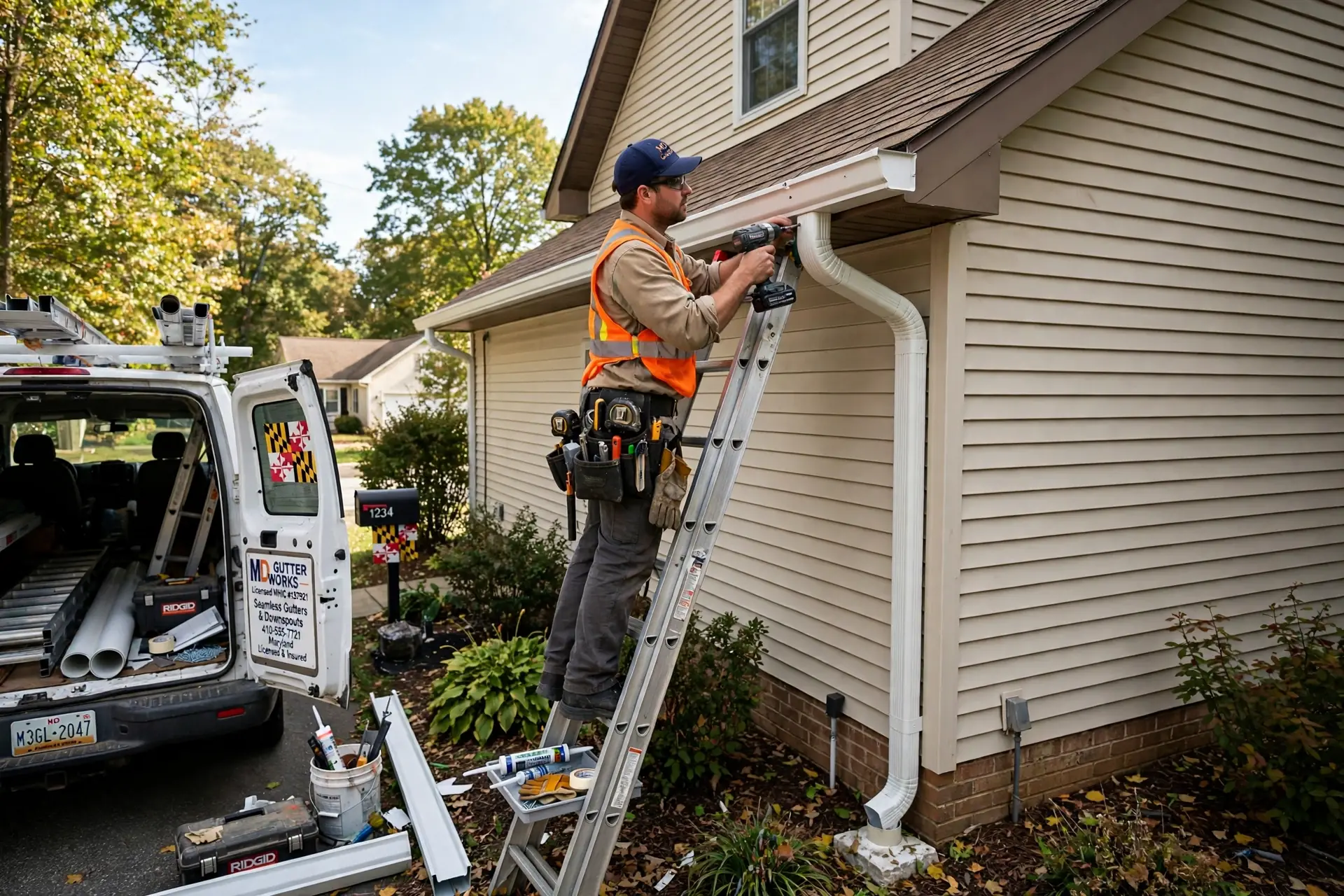
A leaking gutter joint in Severna Park is often a symptom of a drainage system that is out of balance, with incorrect pitch, too few hangers, fascia rot behind the gutter, or a blocked downspout forcing water to back up. Resealing a joint without fixing pitch, hangers and flow will not hold, because standing water will find the next weak joint. The gutter crew in this photo is working on a system section by section, with joints, pitch and downspout flow checked together, so the repair restores drainage, not just appearance. A gutter repair should also check profile and gauge, because a K-style run and a half-round run fail differently, and a sagging section often points to hangers, pitch or fascia, not just to a leaking joint.
Local work on Severna Park roofs means we know how nor'easters, summer storms and freeze-thaw affect gutter repair, and which details fail first in this climate.
We work with the materials that matter for gutter repair — gutter sealant, hangers, joints, downspouts and extensions — and explain why each one is used.
For gutter repair, scope, materials and steps are reviewed before work is authorized, and service availability is confirmed by phone at 410-755-8629. No hidden scope, no vague promises.
Share where joints leak, where sections sag, and whether overflow happens in moderate rain.
We check joints, pitch, hangers, fascia and downspout flow as one drainage system.
Review whether a joint, a section or a larger replacement is the honest fix, before work is authorised.
Joints are resealed, sagging sections are re-secured, pitch is restored, and flow is checked.
Scope depends on the system, not just one joint. These factors decide the gutter scope.
One joint is a reseal; leaks at most corners mean a section replacement is more reliable.
Fascia rot and hanger spacing decide whether a gutter can be re-secured, or needs replacing.
Incorrect pitch and blocked downspouts must be fixed, or a reseal will not stop overflow.
Severna Park first for gutter repair, then these Central Maryland communities, and more in the full directory.
What homeowners say about gutter repair in Severna Park and Central Maryland, in their own words.
"Our gutters were leaking at every joint and sagging in the middle. After repair they are solid, level, and drain properly again."
Homeowner, Millersville
"Leaking joints are sealed, sagging sections are straight again, and water flows properly now."
Homeowner, Severna Park
"Pitch was restored and downspouts cleared, so gutters no longer overflow in moderate rain."
Homeowner, Arnold
"Flow was tested after the repair, and gutters now drain without pooling."
Homeowner, Annapolis
Small leaks can often be fixed by cleaning and drying the affected area, then resealing the seam or joint with an appropriate gutter or silicone-based sealant, with proper surface preparation, because sealant on a dirty or wet joint will not hold. If leaks are widespread, recurring, or at most corners, replacement of the affected section, or upgrading to a seamless system, is usually more reliable than another sealant attempt. Joint seals and corner condition should be checked first, because failed sealant at joints is the most common gutter leak source.
Gutters pull away when fasteners loosen or fascia boards weaken, with common contributors being debris weight, ice buildup, and hanger spacing that is too wide for snow and ice load. A sagging gutter loses pitch, holds water, and puts extra weight on fascia, which then rots and weakens further, so the problem compounds if only the gutter is refastened. Early correction, with correctly spaced hangers and fascia checked at the same time, prevents further separation and reduces water getting behind the gutter.
Yes, gutters rely on a subtle slope, about a quarter inch per 10 feet, to move water toward downspouts, and if slope is incorrect, water pools instead of draining. Standing water increases leak risk, accelerates seal failure, adds unnecessary weight, and in winter contributes to ice dams, which force meltwater under the lower courses of shingles. Pitch and water flow should be checked by eye and by water test, because a gutter that holds water will sag and leak, even if it looks level from the ground.
A common guideline is one downspout for every 40 feet of gutter, though roof size, pitch and corners change that number, and multiple moderate-size outlets distribute water more evenly than one large outlet. Too few downspouts force water to back up inside the gutter, increasing overflow risk and stress during heavy rain, and the symptoms are overflow in moderate rain, spilling at corners, and gutters that remain full after rain stops. Adding a downspout, or upsizing from 2x3 to 3x4, is often the fix, rather than replacing the whole gutter.
Repair is right when damage is limited to one joint, one sagging section, or a few loose hangers, and the rest of the system, including fascia, is sound. Replacement of a section, or a full upgrade to seamless gutters, is better when gutters are rusted through, heavily dented, pulling away in multiple locations, or simply too old to repair reliably, or when they are the older 4-inch size that cannot handle Maryland rainfall. An installer should evaluate the whole system and recommend the most cost-effective solution, not just the cheapest fix.
Pooling near the foundation usually means downspouts discharge too close to the house, or grading slopes toward the foundation, even if the gutters themselves are clean and straight. Downspouts should direct water at least four to five feet away, with extensions where needed, and homes with poor grading may need longer extensions or an alternative discharge location. Gutter and grading work together, so a gutter repair that does not address discharge will not stop basement moisture or soil erosion.
Call to discuss your gutter repair concern and verify current service availability.